Awdal at the Crossroads
History, marginalization, and the rising case for an Awdal-first future

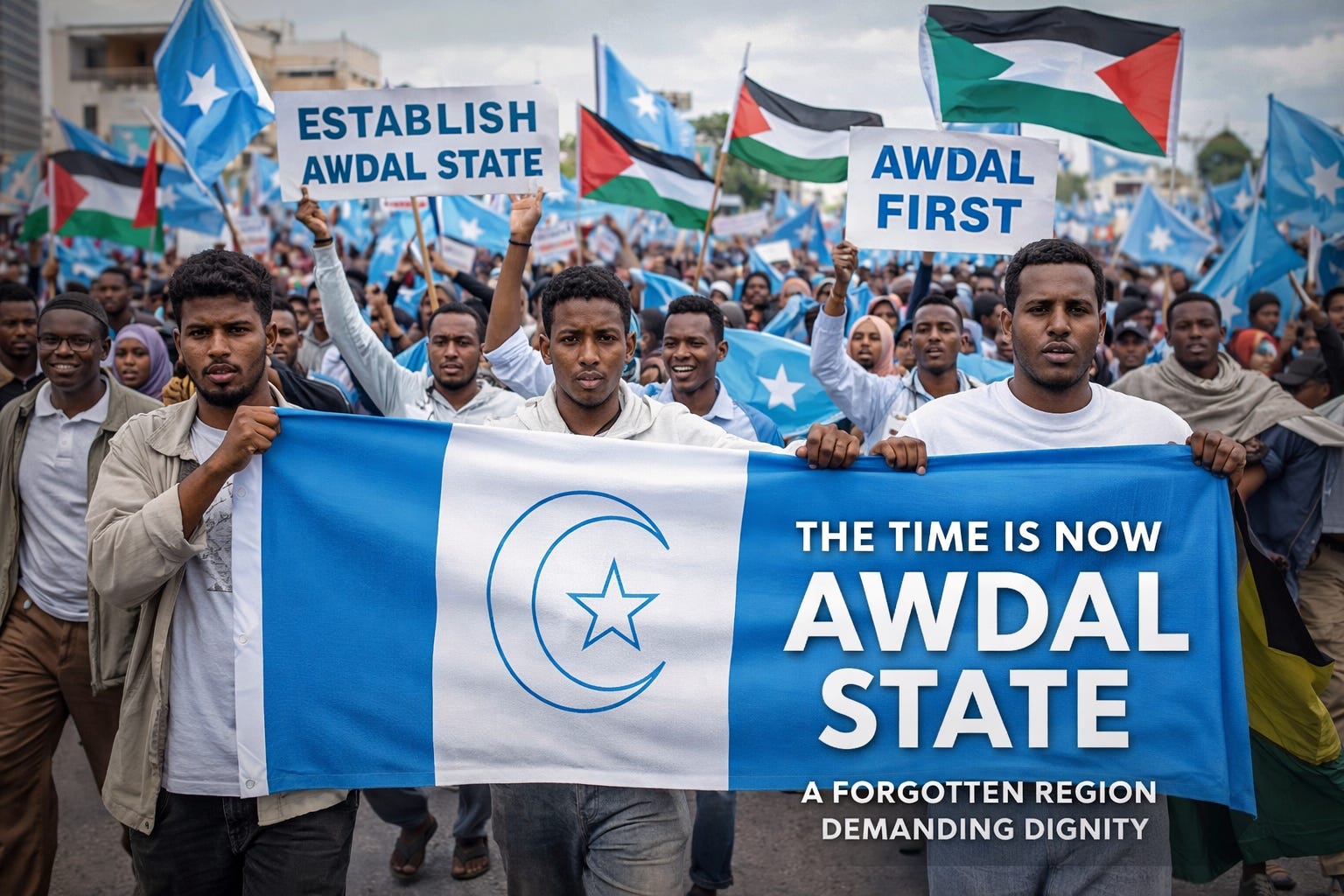
For many in the Somali diaspora, Awdal is a name that exists somewhere between memory and map — a word we’ve heard, a lineage we’ve traced, a place we say we’re from.
But rarely do we talk about it seriously.
Yet Awdal was never small.
Not in history. Not in geography. Not in imagination.
It was made small through politics and power.
And that quiet marginality? It’s ending.
To understand what’s happening in Awdal today, you need more than politics. You have to listen. To history. To institutions. To the young people who are now speaking in voices that can no longer be ignored.
This is not a rejection of Somaliland as an idea. It’s a reckoning — with the road we’ve taken, and the questions we’ve refused to ask.
Awdal’s Central Past
Long before colonial lines cut through the Horn of Africa, Awdal stood at the center of something larger. It anchored the Adal Sultanate — a place of trade, learning, and faith that connected the Horn to Arabia, India, and beyond.
Zeila was not a forgotten shoreline; it was a meeting point of worlds. Ships came and went, languages mixed, ideas traveled.
Even under colonial rule, Awdal remained outward-looking — west to Harar, north to Djibouti, across the Red Sea. Its people were traders, farmers, teachers, and Islamic scholars. They belonged to no single border.
Awdal was never peripheral. It was made peripheral.
And what was made can be remade.
The Birth of Somaliland and the Politics of Origin
When the Somali state collapsed in 1991, Somaliland rose from the wreckage, shaped by the victory of the Somali National Movement (SNM). That victory brought peace to many, but it also defined who held power and who entered later.
The SNM was built mostly from one clan family — not out of malice, but out of circumstance. The result was a new order formed around one social core, extending outward instead of being built together.
Awdal entered that story not as a founding author, but as a chapter added later. That decision shadowed everything that followed.
The SNM Manifesto and the Inheritance of Mistrust
In March 1991, inside the SNM’s leadership, a manifesto circulated — outlining how to secure power after victory.
It was written in the language of caution, not inclusion. It spoke of control, surveillance, and the management of rivals. It treated unity as a risk to stability.
Out of that worldview grew a culture of mistrust — not through one decision, but through years of policy, silence, and security-first governance.
In places like Awdal, political participation was seen as potential disruption. Dissent became disloyalty. Questions became threats.
And so, trust never had a chance to grow.
The Long Memory of Violence
These are not abstract things.
In Borama, people still remember the days when houses emptied overnight.
In Zeila, there are graves with no markers.
Those years after Barre’s fall, in the early 1990s, were brutal — killings, flight, silenced pain.
But what hurt most was the silence that followed. No truth commissions. No national mourning. No public reconciliation. Just a collective decision to forget what could not be buried.
That memory lives quietly — in stories told by elders, in the hesitation of parents, in the questions their children are now asking out loud:
Why did no one ever say our pain mattered?
The Daily Face of Marginalization
Marginalization doesn’t always look like oppression. Often, it looks ordinary.
It’s when roads stop being built before they reach you.
When graduates wait years for jobs that don’t exist.
When Zeila remains a sketch in development documents instead of a functioning port.
When national decisions are made about Awdal’s land, sea, and future — without a single serious Awdali voice in the room.
You could feel it again when Somaliland’s deal with Ethiopia was announced, involving Awdal’s coastlines — without consultation.
You could see it when Somaliland publicly celebrated Israel’s recognition, while Awdal’s youth marched in solidarity with Palestine and Somalia.
They weren’t just protesting policy. They were protesting erasure.
The Rise of Awdal’s Youth
What’s happening now is generational.
The grievance isn’t new — the voice is.
Awdal’s youth are educated, connected, unafraid. They don’t wait for permission to speak; they publish, organize, build networks across cities and continents.
They aren’t funded by foreign powers or old elites.
They come from classrooms in Borama, deserts near Zeila, diaspora WhatsApp groups, and kitchen-table debates.
Their message is not complicated:
We exist. We matter. And we will no longer be spoken for.
That energy can’t be contained anymore — not by pressure, not by silence.
Why “Awdal-First” and Statehood Are Emerging
The call for an Awdal-first approach isn’t a threat. It’s self-respect.
It’s saying: loyalty has to mean something tangible.
People haven’t turned against Somaliland. They’ve turned against being perpetually peripheral.
They ask: If our voices don’t shape this system, why not build one where we do?
Federalism, despite its flaws and unfinished nature, offers frameworks for agency — self-rule, direct engagement, shared power.
A Federal Awdal State is not secession.
It’s survival with dignity.
What an Awdal State Could Become
If given the tools, Awdal could:
Rebuild Zeila into a functioning port and economic hub
Serve as a trade corridor to Ethiopia and Djibouti
Invest in farming, logistics, and higher education
Attract diaspora investment through accountability
Lead local reconciliation grounded in justice, not power
In short: it could finally turn endurance into progress.
The Turning Point
Awdal is not angry because it wants more.
It is impatient because it has waited too long.
It has been loyal. It has been quiet.
And it has been excluded.
That patience is ending.
What’s emerging is not rebellion — it’s reclamation.
Awdal is stepping forward, not to destroy, but to participate fully — to belong on its own terms.
To be heard. To be seen. To rewrite what “marginal” means.
That is not a threat to Somaliland or Somalia.
It’s an invitation — to build something fairer, stronger, and finally whole — together.